


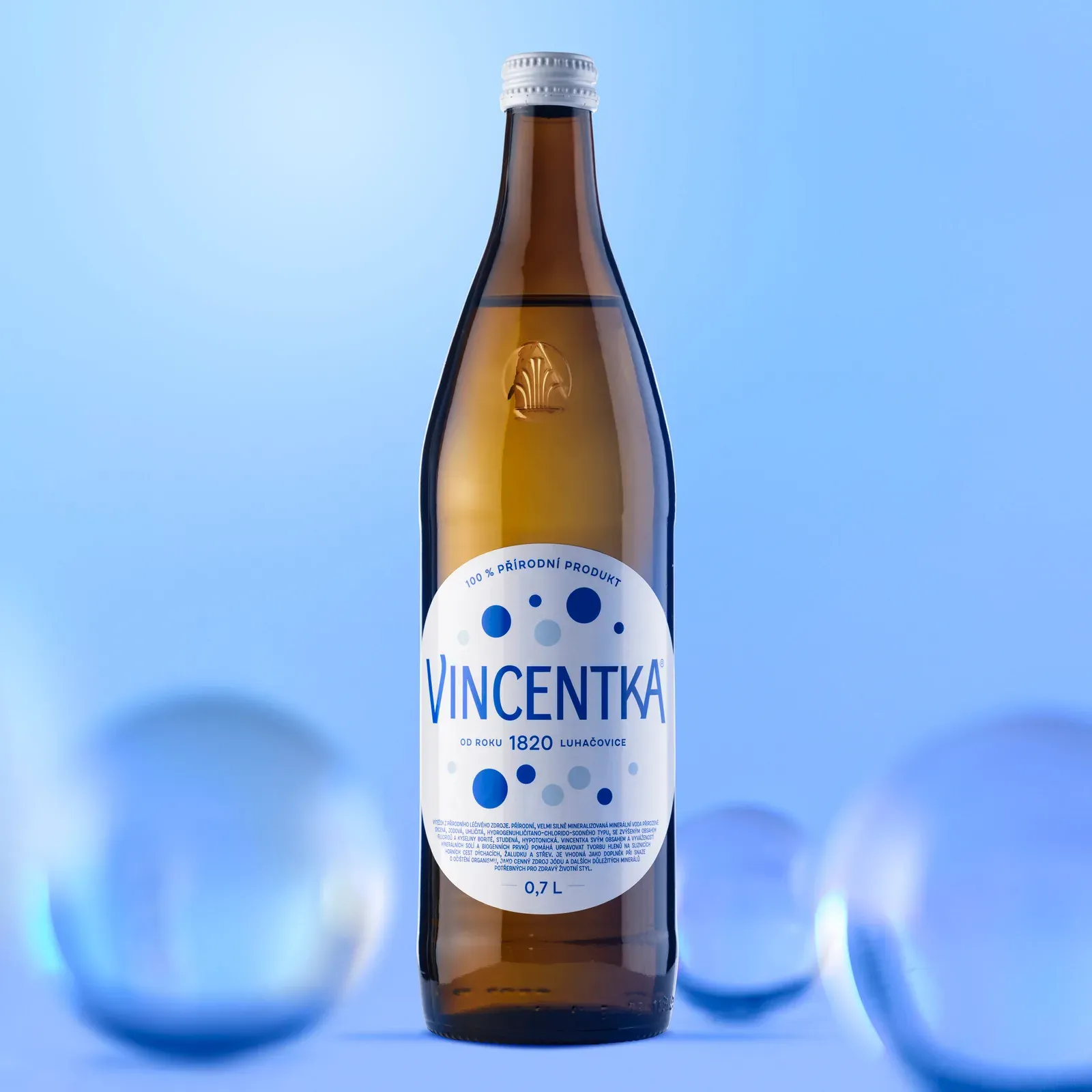
Vincentka mineral water 700 ml
Through its content and its balance of mineral salts and elements, Vincentka helps dissolve mucus in the respiratory tract, the stomach and the intestines. It is recommended for drinking and inhalation courses in illnesses of the airways and vocal cords, in metabolic disorders, peptic ulcer of the stomach and duodenum and their post-operative states, diabetes and chronic inflammation of the pancreas.
100% natural product — drawn from a natural medicinal spring.
- children 3+
- pregnant women
- breastfeeding women
- athletes
Detailed description
Vincentka helps restore the body’s internal environment after heavy loss of sweat, which occurs during hard physical work, sport, time spent in hot surroundings and feverish illness.
Vincentka suits the prevention of tooth decay in children, at 0.25 l a day.
Vincentka can cover the daily dose of iodine — 25 ml, a single mouthful, is enough. It contains biogenic elements such as lithium, rubidium, caesium, copper, zinc, vanadium, chromium and cobalt in physiological proportions and suits athletes, children, pregnant women and convalescents as a natural food supplement.
Vincentka is a supportive remedy after excessive alcohol.
It is contraindicated only in people with failing kidneys. Care is needed in patients with kidney disease and with swelling of the lower limbs, though even there Vincentka may be taken after consulting a doctor.
How to use it
Drinking course — Vincentka is usually taken twice a day, on an empty stomach before breakfast (150 ml) and again before dinner (150 ml). An effective course lasts 21 days. Drink it cold or warmed. Eat and drink nothing for the next half hour.
Gargling and nasopharyngeal rinsing — Vincentka nasal spray can be used as well.
Inhalation
Prevention — drink it cold, or use it to dilute fruit juices, to dress vegetable salads and as a chaser with alcohol and coffee.
With wine — chilled and mixed with a good dry wine one to one, it makes an excellent spritzer and lowers the acidity of the wine.
Tooth decay — rinse the mouth with it as prevention.
Composition
Chemical analysis after iron removal, values in mg/l.
Cations: Li⁺ 9.1 · Na⁺ 2,170 · K⁺ 143 · Ca²⁺ 304 · Ba²⁺ 6.03
Anions: F⁻ 2.7 · Cl⁻ 1,600 · I⁻ 5.2 · HCO₃⁻ 4,490
Undissociated HBO₂: 284
Total mineralisation: 9,060 · natural CO₂: 3,100 · pH: 6.7
Iodides: 522 µg/100 ml, that is 348 % of the reference intake. The full analysis is on the About Vincentka page.
Packaging
700 ml in a non-returnable glass bottle.
Frequently asked questions
Did not find your answer? Write to us and we will gladly reply.
How do I inhale Vincentka properly?
Inhalation is most effective with an inhaler. Vincentka recommends inhalers from OMRON, which we also offer in our e-shop at favourable prices. They are simple to use and need only a small amount of solution, all of which is used. The greatest effect comes with a mask over the mouth and nose, which makes for a genuinely thorough inhalation.
What do I do if I have no inhaler?
Pour Vincentka into a stainless steel pot (about 2–3 cm) and heat it slowly until steam starts to rise — it must not boil. When the steam comes, put a towel over your head and lean carefully over the pot, far enough away not to scald yourself. Then simply breathe normally for five to ten minutes. Take great care not to scald or burn yourself on the hot pot, and never let children inhale unsupervised.
How long can I use Vincentka after opening the bottle?
It should be used within ten days of opening at the latest, and that assumes the natural carbon dioxide has not escaped entirely and that salt crystals have not started to form in the bottle. Much depends on how often it is opened and how well it is closed; a bottle with a screw cap, kept cool and dark, suits it best. Even so, it is best used within two days of opening.
Does boiling Vincentka — driving off the bubbles — change its quality?
Boiling crystallises the minerals and trace elements and makes them hard for the body to absorb. The taste changes too. The bubbles, that is the natural carbon dioxide — Vincentka is not carbonated artificially — have their place in the make-up of the water and hold its chemical composition in balance. Anyone who does not tolerate carbon dioxide can stir the bubbles out while the water is cold, but must then use it quickly.
Can I drink Vincentka during pregnancy?
Vincentka is recommended during pregnancy for its natural iodine and other minerals, which have a favourable influence on its course. Bear in mind, though, that it also contains salt, which is worth limiting during pregnancy — so while drinking Vincentka, salt other food less. The usual daily amount is 200–300 ml. As to how much a day, we recommend consulting your doctor.
Is Vincentka suitable for infants, and how should it be dosed?
Among other things, Vincentka contains a considerable amount of iodine. The dosage must be discussed with a doctor.
With so much salt, can Vincentka affect the heart and blood vessels?
Vincentka is not a water for quenching thirst. It is drunk as a support in replacing minerals and trace elements. It works like any other food: while drinking Vincentka, leave out food with a higher salt content at the same time. When mineral salts are being lost heavily — during diarrhoea or physical exertion — salt intake need not be limited at all.
Why is Vincentka not sold in returnable bottles?
Our bottles are made as non-returnable, so they use 30 % less glass than a returnable bottle, which saves raw material and energy in production and fuel in transport. About half of our output is sold in pharmacies, which do not want to take returnable bottles back. We are a very small producer and could not run a returnable cycle at an acceptable cost, and washing bottles takes a great deal of energy. If our bottle reaches sorted waste, it is certain to be recycled — and the glass it is made from already contains 70 % recycled material.
Why do you not sell Vincentka in PET bottles?
Vincentka is a highly mineralised natural medicinal water, unique in Europe in its composition. We want to keep that quality as nature offers it. Vintage wine does not belong in a PET bottle either.
Where can I buy Vincentka?
Vincentka is available in every pharmacy in Czechia. Food shops can order it from beverage wholesalers, though only some do — usually Albert, Tesco, Kaufland, COOP, Hruška, Globus and InterSpar.
How much Vincentka and water go into an inhaler, and for how long should I inhale?
The method and the duration of inhalation must be discussed with a doctor.
Are Vincentka bottles returnable?
Since May 2005 Vincentka has been filled only into non-returnable bottles. The bottle is made of thin-walled glass and belongs in the glass container after use.
How long does an opened bottle last for inhalation and nasal rinsing?
Vincentka should be used within ten days of opening at the latest, and that assumes the natural carbon dioxide has not escaped entirely and that salt crystals have not started to form in the bottle. For better keeping, a brown glass bottle with a screw cap is preferable; they are sold in pharmacies and in some food shops.
Has the taste of Vincentka changed over the years?
Yes, it may well have, and three things lie behind it. Packaging — between 1977 and 1988 Vincentka was sold in a hardened PVC bottle with aluminium foil instead of a cap. That packaging was entirely unsuited to carbonated water: the carbon dioxide escaped quickly, the water oxidised in the bottle and its taste changed markedly. Today we use glass bottles with a screw cap, which keep it best. Iron content — since 1995 the iron has been removed, because it oxidised in the bottle and formed a sediment. Iron has a taste of its own, which does not suit everybody; on the colonnade in Luhačovice you can have Vincentka with its iron and compare. Production technology — filling today is on a different level than forty years ago. The whole line is stainless steel and the process is entirely closed, which keeps oxygen away and with it any oxidation or change in the chemical composition.