


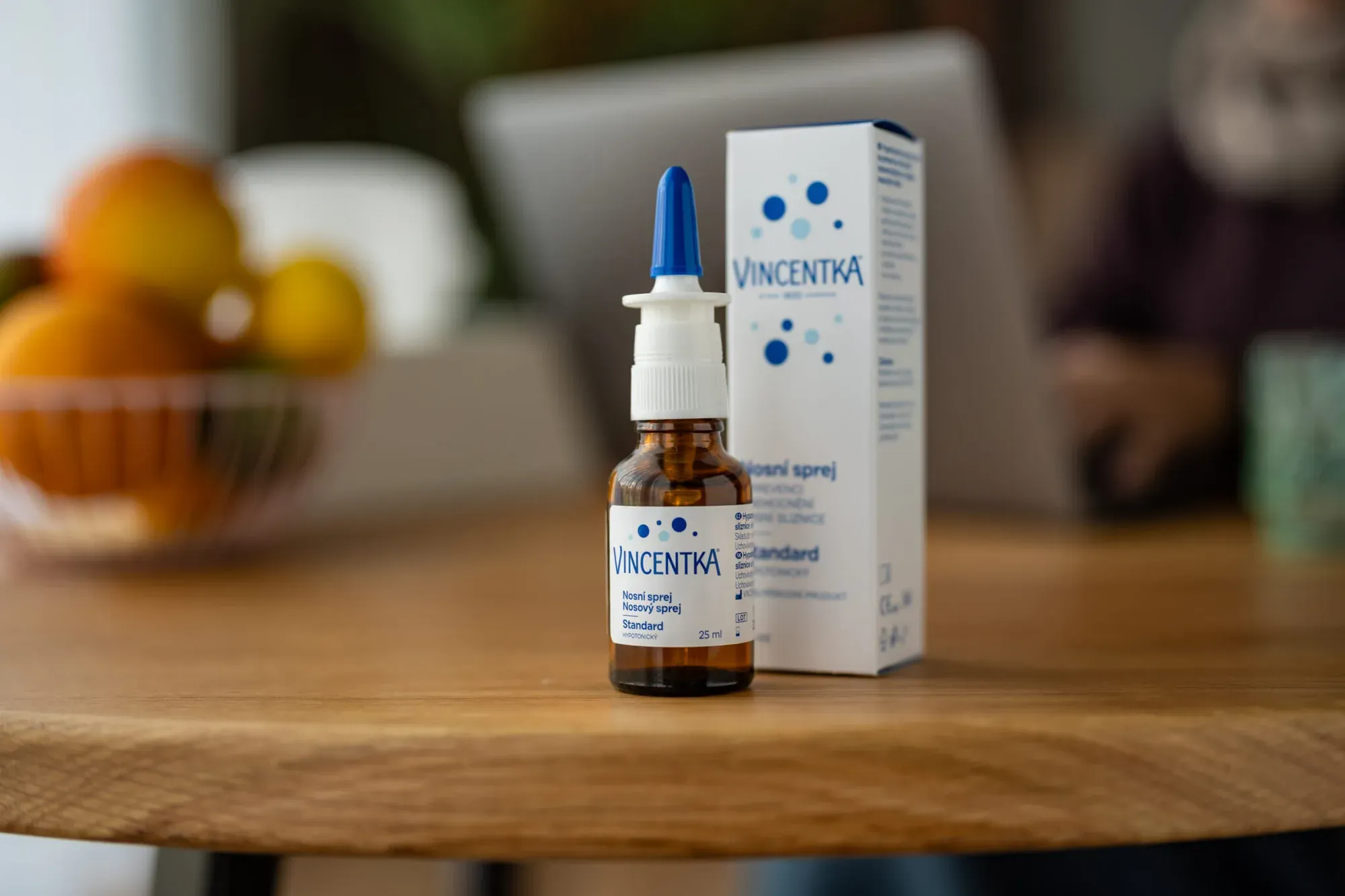
When the nose is blocked, most of us automatically look for a “stronger” solution. A higher salt concentration, quick relief, the feeling that the spray has really worked.
But the nasal mucosa is not a passive obstacle that needs to be “forced”. It is a living protective system that works best when it has the right conditions.
This is precisely where the Vincentka nasal spray differs from ordinary sea waters. Its effect does not rest on the strength of the salt, but on supporting the natural function of the nasal mucosa.
The nasal mucosa: a protective system that needs care
The nasal mucosa is the body's first line of defence. It traps dust, viruses and bacteria, and by means of mucus
and microscopic cilia it naturally carries them out of the nose.
Mucus production is not a problem, it is the body's natural defence mechanism. The problem arises the moment mucus builds up and cannot be carried out naturally. By beating, the cilia of the nasal mucosa move the mucus together with viruses and bacteria out of the sinuses, but during a runny nose, a cold or a stay in an air-conditioned environment they are often slowed down or weighed down by thick mucus and do not work properly. In order to work properly again, they need a gentle
and sufficiently moistened environment.
And this is exactly where Vincentka comes in.
Why Vincentka is different from ordinary sea waters
Vincentka nasal spray contains the same Vincentka that people know from the original bottle. It is not
an artificially prepared saline solution, but a mineral water from a natural medicinal spring which formed over tens of millions of years without technological intervention. It contains a natural complex of 18 minerals and trace elements, including sodium, chlorides and hydrogen carbonates, not merely dissolved salt.
Vincentka is naturally hypotonic, which is not a shortcoming but on the contrary an advantage of its origin. Thanks to its balanced composition it acts gently on the nasal mucosa and supports its natural moistening, dissolves mucus and restores the self-cleaning function of the cilia. Vincentka's effect does not rest on aggressively “drawing out” fluids with a high salt concentration, but on supporting the natural defence mechanisms of the nasal mucosa, which makes it suitable even for repeated and long-term use.
How to choose the right nasal spray
Choosing a nasal spray should not be a question of “which is stronger”, but above all of which problem of the nasal mucosa you are currently dealing with. Nasal sprays are often divided by salt concentration into hypotonic, isotonic and hypertonic. These terms may sound complicated, but in practice they describe only one thing, how the solution behaves towards the cells of the nasal mucosa.
Different types of nasal spray work on different principles and each has its place – from ordinary everyday care through to a targeted solution for pronounced difficulties. Vincentka belongs among the hypotonic solutions. The character of Vincentka is a natural consequence of the long-term natural development of residual sea water and its effect is unique in its overall mineral composition and in its principle of action.
The basis of everyday care – Vincentka nasal spray
Vincentka nasal spray is a suitable basis for everyday care, as it moistens the mucosa, helps to dissolve mucus and supports the natural self-cleaning function of the nose. It is therefore suitable for an ordinary runny nose, a cold, a feeling of dryness in the nose or as prevention when staying in a dry or air-conditioned environment. It contains the natural complex of minerals and trace elements of residual sea water, not merely salt. Its effect does not rest on a high salt concentration, but on a balanced natural composition.
Thanks to its gentle action, Vincentka nasal spray is suitable for repeated and long-term use, in adults as well as in children including newborns.
A higher level of care: Vincentka Nasalis
If the nasal mucosa is burdened, irritated or weakened over the long term, ordinary care may not be sufficient. Typically these are conditions following repeated bouts of a runny nose, during a long stay
in dry air, after using medicinal nasal sprays against a runny nose or in the case of chronic difficulties.
In these cases the Vincentka Nasalis product comes into play, representing a higher level of nasal mucosa treatment thanks to its greater concentration. It builds on the principles of Vincentka – the use of natural residual sea water – and extends them with more intensive care aimed at protecting and regenerating the nasal mucosa.
Vincentka Nasalis is not intended only for moistening, but for targeted support of the mucosa in situations where its natural function and resilience are disrupted.
Short-term help: hypertonic sea water
Hypertonic sea waters contain a higher salt concentration. Their effect is based on the osmotic principle – they quickly draw excess fluid out of the mucosa and can thereby bring short-term relief in cases of pronounced swelling and a severely blocked nose.
They are suitable above all for short-term and targeted use. With long-term use they can dry out and irritate the nasal mucosa, which is why they are not suitable as a solution for everyday care.
So how to decide correctly? The basis is always to assess the state of the nasal mucosa. For ordinary care and support of the natural functions of the nose, Vincentka nasal spray is suitable. For long-term or more pronounced difficulties it makes sense to choose Vincentka Nasalis as a higher level of treatment. Hypertonic sea water has its place above all as short-term help with severe blockage of the nasal sinuses.